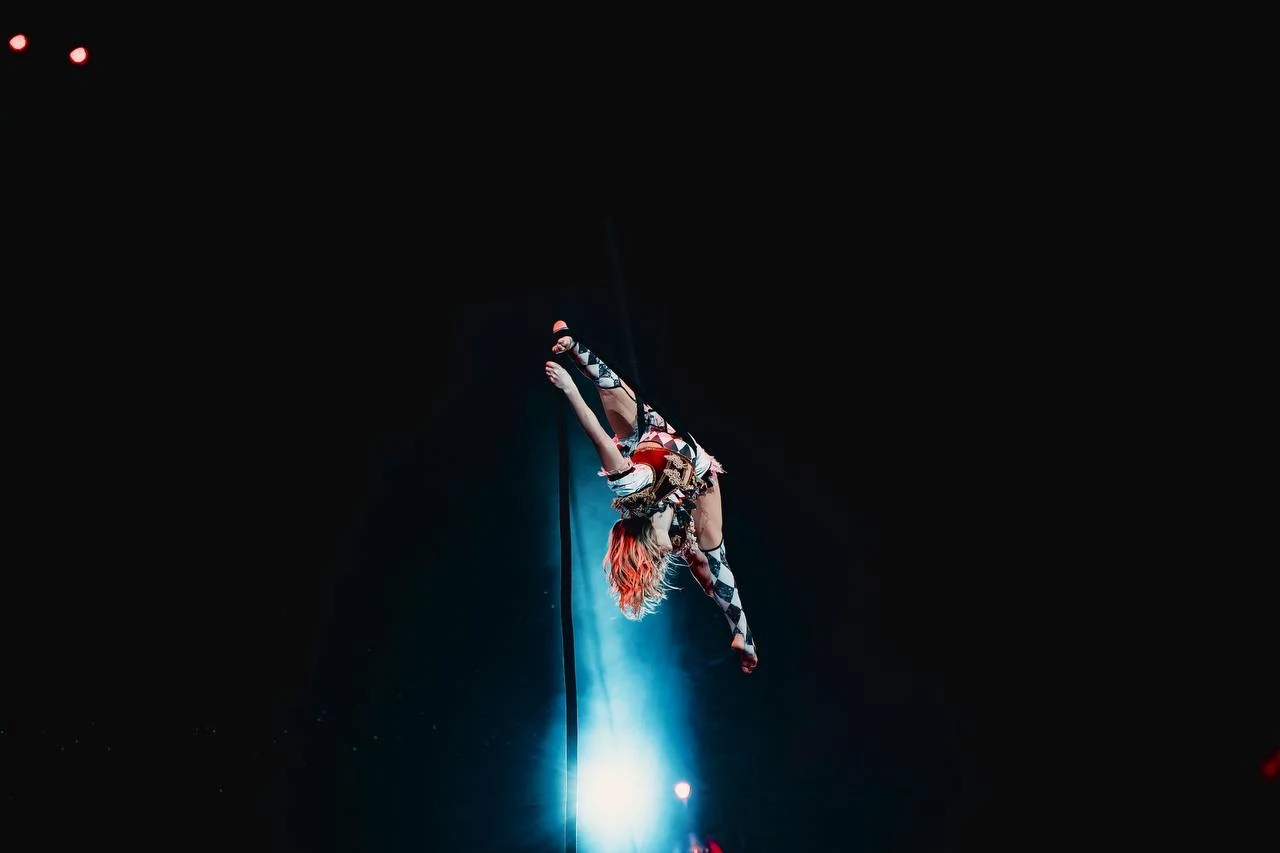
Hello! My name is Evgeniy Olegovich Malikov, and today I would like to introduce you to one of the most fascinating pieces of circus apparatus, deceptively simple at first glance: corde de péril, or, as we usually call it, the rope.
In 2010, I graduated from the State College of Circus and Variety Arts as a gymnast specialising in corde de péril. Today, I have been teaching aerial gymnastics for more than ten years. During that time, I have not only mastered a wide range of skills but also developed my own approach to training, which I would like to share with you.
A little history and an unusual name
The name “corde de péril” comes from French and can be translated as “rope of peril”. There is a certain logic to the name: the performer is high above the ground, and the entire act revolves around a single rope suspended vertically.
Rope climbing was once primarily an exercise in strength and endurance, used in gymnastics and military training. Over time, however, simple climbing developed into a circus discipline in its own right.
Today, corde de péril performances feature not only feats of strength but also graceful transitions, intricate wraps, spins and breathtaking drops. Yet the foundations remain the same: the performer, the rope and the ability to control one’s own body.
Where does rope training begin?
When students come to me, I always start with the simplest thing: climbing.
Endless climbs up the rope may seem like a rather dull part of training, especially when you are eager to move on to the spectacular skills we are used to seeing in circus acts.
But this is precisely where the foundation for everything that follows is laid.
The defining feature of corde de péril is that the performer supports their weight on the rope almost constantly. This means developing not only arm strength but also forearm endurance, a confident grip and sound technique.
In my training sessions, I place a strong emphasis on sustained work on the apparatus. By gradually increasing the time spent on the rope, students learn to pace themselves, find comfortable positions and develop an awareness of their own bodies.
It is important not to push yourself to complete exhaustion: the workload should increase gradually, and safety must always come first.
Only when a student’s grip is sufficiently secure do I suggest moving on to artistic transitions, wraps, spins and more complex skills.
Even experienced performers should not forget simple climbs. They are a foundation worth returning to throughout a career.
What kinds of rope are there?
Ropes have changed considerably over the years I have been working with them.
When I began training, we used an ordinary three-strand cotton rope. It was fairly stiff, with a pronounced texture, and every twist would quite literally leave its mark on the skin.
After long training sessions, our hands, legs and other parts of the body that had been in contact with the rope bore the evidence. At the time, though, this was simply accepted as part of the work.
There was another way of making ropes, too: people made their own from fire hoses, adding a soft filling inside. These ropes differed from traditional three-strand ropes in both surface texture and softness.
Today, the choice is much wider. Alongside classic three-strand ropes, there are braided ropes and soft models with a smooth textile surface.
Personally, I prefer a braided rope. I like its relatively smooth surface, the secure grip it offers the hands and its suitable weight for performing drops.
During slides and unwinding movements, this type of rope is also less prone to developing kinks and folds. In my experience, it is reasonably durable as well.
That said, classic three-strand ropes remain a benchmark for durability. A long service life is one of their main advantages.
A steel cable is woven into the core of this type of rope, with a hand loop and a swivel attached to it. Holding the loop, the performer can execute one-arm spins, hangs and other striking skills. The swivel allows free rotation without twisting the rope itself.
For beginners, however, I often suggest considering softer options. They are more comfortable when first getting to know the apparatus and cause less chafing. Of course, softness alone does not determine whether an apparatus is safe: the quality of the equipment and the way training is organised are what matter here.
Ultimately, the choice of rope depends on the performer’s preferences, technique and the demands of the planned act.
Chalk, rosin and a confident grip
Another question that often comes up during training is the use of products to improve grip.
Many performers today use chalk, rosin and various mixtures based on them. I try to keep their use to a minimum.
There are several reasons for this.
First, when you sweat heavily or apply too much, some products can have the opposite effect: instead of a secure grip, you start to slip.
Second, regular use can leave a build-up on the rope’s surface and affect its condition.
Finally, in my view, learning to work correctly with the apparatus and developing grip strength and technique are far more important than constantly relying on additional products.
This does not mean that chalk or rosin should be abandoned altogether. Every performer is different, and much depends on the apparatus being used. But I am convinced that the first priority is learning to feel the rope.
The key is to keep going
Corde de péril is a remarkable piece of circus apparatus. On the surface, it is just a rope, yet the possibilities it offers a performer are almost limitless.
It demands patience, physical conditioning, attention to detail and continuous work on yourself. Not everything comes together on the first attempt, and some skills take many weeks or months of training.
But that is precisely where the pleasure of learning something new lies.
I always tell my students: “The road is mastered by those who keep walking.”
So, to everyone just beginning their journey with corde de péril, I wish you patience, perseverance and enjoyment in your training.
Do not be afraid of difficulties. Love what you do, and remember that even the most complex circus act once began with a first climb up the rope.
Welcome to the wonderful world of aerial gymnastics!