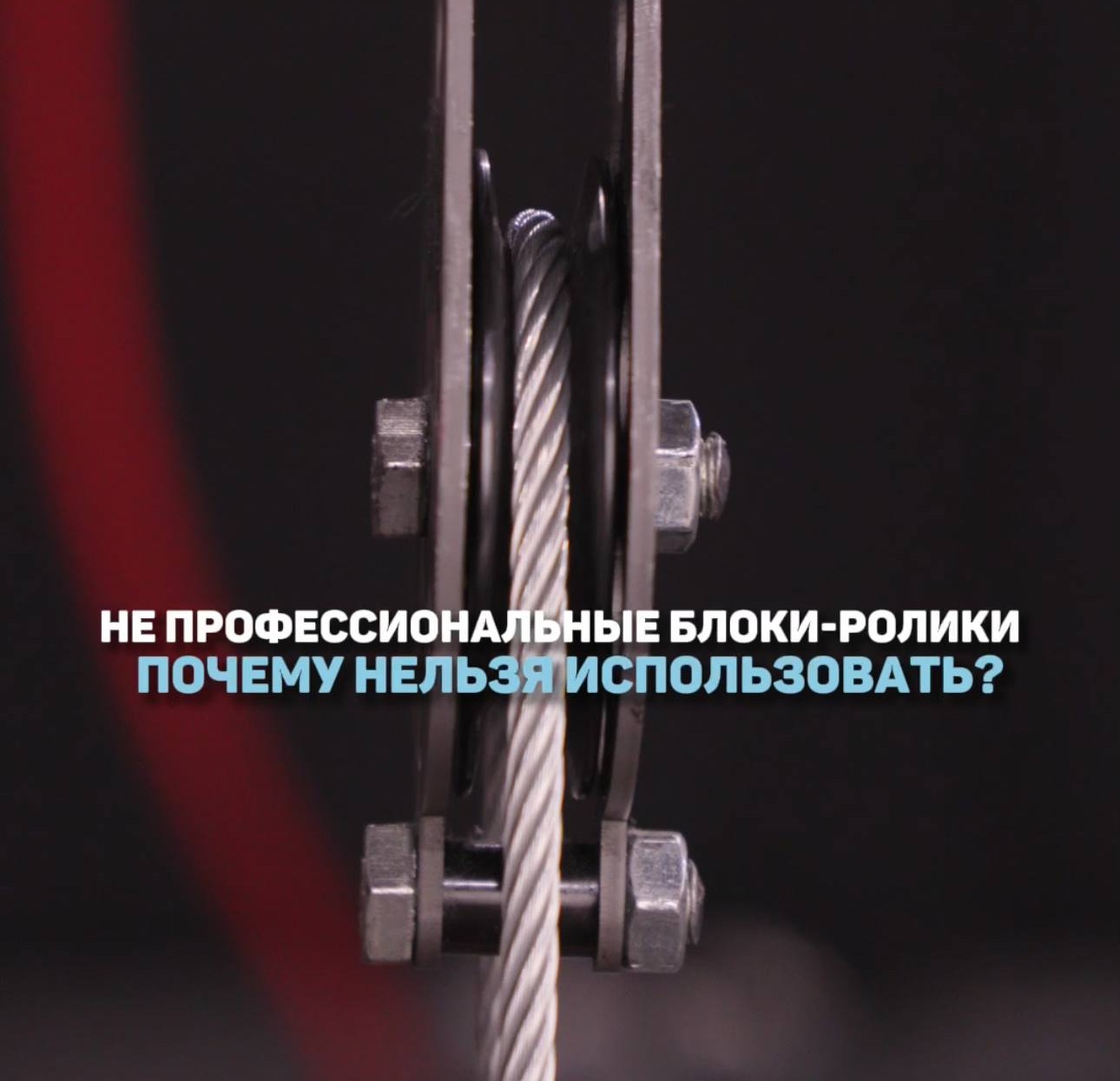
A pulley block redirects steel wire rope in a suspension system and transfers the load to an attachment point. An incorrect sheave diameter, groove profile or casing design can damage the wire rope even while the block still appears intact.
In this article, an “unrated” block means a product with no confirmed intended use, working load, product passport or identifiable manufacturer. Price and appearance are secondary. A compact pulley designed for building hardware, fitness equipment or household machinery may work well in its original assembly, but that does not make it a lifting block suitable for systems that move people.
Select the block and steel wire rope as one system
The wire rope bends and straightens on every pass over the block. A small sheave diameter increases wire strain and accelerates bending fatigue. An unsuitable groove pinches the rope from the sides, while an oversized groove does not keep it on the intended path. A burr or sharp edge can damage the rope’s outer wires in a few cycles.
Russian Ministry of Labour Order No. 914n contains specific requirements for blocks used with circus equipment. Clause 431 requires free rotation, clean surfaces without cracks or sharp edges, a suitable groove and clearance between the steel wire rope and casing. For a block over which the rope passes, the order sets the relationship D = 16d, where D is the permitted block diameter and d is the rope diameter. A smaller block must be replaced.
GOST 33710-2015 treats the selection of wire ropes, drums and blocks as one engineering task. The standard links rope parameters to the mechanism’s purpose, duty and the geometry of the components that guide the rope. A block cannot be selected only because the rope fits inside the groove.
Where an unrated pulley fails
A block has several load-bearing parts: the sheave, pin, bearing, side plates, suspension eye and fasteners. A lifting-block manufacturer states the working load for the assembled product. A rating stamped on a bearing or bolt does not establish the capacity of the complete block.
A pulley of unknown purpose creates recurring risks:
- The steel wire rope binds in the groove. The rope moves with increased friction, and the excess force transfers to the attachment or winch drive.
- The steel wire rope leaves the groove. It enters the gap between the sheave and side plate, catches on an edge or blocks movement.
- The pin bends. The side plates spread, the sheave tilts and the bearing receives a load for which it was not selected.
- The steel wire rope develops early fatigue. The system continues moving while the wires accumulate bending damage and reach discard criteria sooner.
The last condition can remain hidden during rehearsal. The operator sees normal movement while the wire rope’s service life is already decreasing. GOST 33718-2015 requires an organised process for wire-rope care, inspection and discard. Correct block selection protects the calculated rope life but does not replace those checks.
Working load and breaking load
Breaking load records the load at failure under specified test conditions. Working load accounts for the permitted operating regime and design factor. A buyer needs a clear WLL or equivalent working rating, the conditions attached to that rating and any limits on load direction.
The force at a block attachment can exceed the tension in one rope leg. It depends on the angle between the entering and leaving legs. When the block redirects the wire rope, the leg forces combine as vectors. A marked block can still be overloaded if the system has not been calculated.
Acceleration, braking, shock and jamming add dynamic force. The designer determines the maximum force for normal and abnormal scenarios, then selects the block, attachment and suspension point as one load path.
What to require from a lifting block
Before installation, we verify:
- the product is intended for lifting work;
- readable working-load marking and model identification;
- a product passport, manual and manufacturer details;
- groove compatibility with the wire-rope construction and diameter;
- permitted load directions and the specified attachment method;
- protection against wire-rope escape and entrapment;
- free rotation without play, misalignment or side-plate contact;
- no cracks, deformation, corrosion or sharp edges.
Inspection in service
A rating does not provide permanent approval. Inspect the block before use and remove it from service after impact or overload until a competent person checks it. Bearing noise, stiff rotation, groove wear, pin play and marks where the wire rope has touched a side plate all require assessment.
Order No. 914n limits groove wear to 3 mm for the circus blocks covered by its provisions and requires replacement when the block diameter is insufficient. Do not transfer those limits to every product without checking its documentation. A manufacturer may set a stricter discard criterion, which then governs the product.
Applicable documents
TR CU 010/2011 requires machinery designers and manufacturers to reduce risk, provide protective measures and issue operating documentation. Russian circus and entertainment venues also use Ministry of Labour Order No. 914n, as amended on 29 April 2025. Hazardous production facilities may fall under Rostechnadzor Federal Rules No. 461 in their current revision. The facility status and lifting-equipment type determine whether those industrial-safety rules apply.
Russian crews sometimes use the old shorthand PTB for safety rules. Project documentation should identify the current technical regulations, occupational-safety rules, federal industrial-safety rules and standards by their proper titles and editions.
References
- Russian Ministry of Labour Order No. 914n, requirements for circus equipment and blocks.
- GOST 33710-2015, Cranes: Selection of wire ropes, drums and sheaves.
- GOST 33718-2015, Cranes: Wire-rope care, maintenance, inspection and discard.
- TR CU 010/2011 on the safety of machinery and equipment.
- Rostechnadzor Federal Rules No. 461 for hazardous production facilities using lifting structures.
Pulley blocks for different wire-rope diameters
- single pulley block for 4-6 mm wire rope, 300 kg;
- single pulley block for 6-10 mm wire rope, 700 kg;
- single pulley block for 10-14 mm wire rope, 1500 kg.
Match the groove diameter, working load and attachment layout to the wire rope and system calculation. Other versions are available in the pulley block catalog.
Conclusion
A professional block has a confirmed working load, keeps the steel wire rope in its intended geometry and supports regular inspection. A pulley with no declared purpose or documentation leaves its material, service life and failure mode unknown. It has no place in a system supporting a load, circus apparatus or person.