Hello!
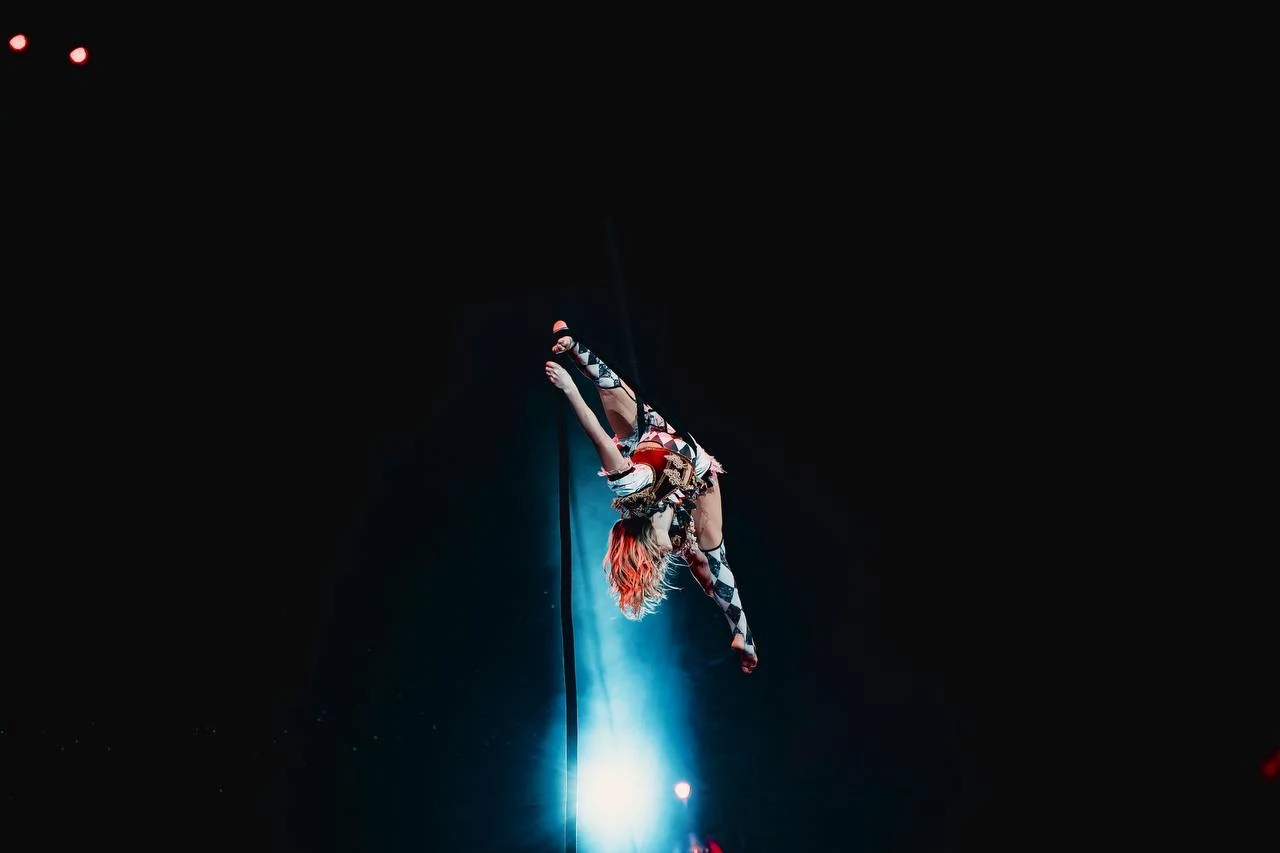
I am Ekaterina Shustova, a circus artist with many years of experience, an aerial silk performer, and a gold and silver medalist at International Circus Festivals in Russia, Italy, France, and Monte Carlo.
Please allow me to share my experience and offer you a short guide to what to look for when choosing fabric for aerial silks.
For children, for those taking their first steps in aerial gymnastics, and for those who still devote most of their training to general physical conditioning, it is best to use fabrics such as satin, sateen, stretch satin, and stretch sateen. These materials do not stretch. The face is shiny, and the reverse is matte. The fabric is 1.5 m wide. Its medium weight makes it comfortable to hold in a child’s hand. With frequent use, especially when children use grip aids (rosin or “Dead Grip”), the fabric can bunch up like an accordion and cause slight discomfort in knots.
These silks make it easy to learn how to wrap both legs for a split at the same height and tie hand knots. Large or sudden drops with hard stops can cause discomfort in the joints and lower back.
If you want to try a fabric with a little more stretch, you can use gabardine or Pikachu. The fabric is 1.5 m wide, but these materials are denser, so they may feel thicker in your hand than satin or sateen. You can cut the fabric lengthwise along the grain, BUT ❗ YOU MUST ❗ then hem the entire length with reinforced thread, folding the edge over.
You can also use nylon when you begin training. The fabric is 2.5 m wide, but its low density means it does not feel thicker in your hand than satin or sateen. It has a moderate amount of stretch.
Experienced artists in good physical condition, as well as artists performing large, high-amplitude drops, can choose knit fabric made in Korea or Vietnam. A “Peacetex” stamp, followed by “100% polyester,” usually appears at the beginning of the roll. The fabric stretches; many people may feel that it stretches too much, but after a couple of rehearsals, the working height stretches out and becomes comfortable.
There is also “oil” knit fabric. It stretches more than ☝🏻 Korean knit fabric, but you can stretch it out to a level that feels comfortable.
With these stretchy materials, you may not manage to wrap your legs for a split at the same height straight away. Repetition will solve this. 😀
If you plan to perform release tricks in your act, non-stretch silks will suit you better because the cushioning effect of knit fabrics will disrupt the momentum of your swings.
I recommend hemming both edges along the full length of any of the fabrics listed above. Fold the edge over and use reinforced thread with a zigzag stitch.
This will strengthen the edge against unwanted crosswise tears.
Remember that fast slides, slips, and drops in which the silk runs sharply through a knot against your body or costume can cause burns.
Both the costume and the silks can burn through.
I dust my costume with a small amount of ordinary rosin in places where the silk may slide. This helps prevent sliding and, as a result, burning.
One more important point: if you choose a new type of fabric that you have never worked on and no other aerialist has used, send a small sample for load testing. Let professionals apply a load and determine how many kilograms the fabric can hold. A fabric’s safety margin is your safety.
I wish everyone safe, light flights and soft landings.
With love and great respect, especially for Circus Workshops,
Ekaterina Shustova.