Hello. I am Konstantin Sherstnev, a circus artist. I started working with the Cyr wheel in Russia in 2008. I performed with it on a raised stage, and in 2016 I opened my own Cyr wheel school. I also continue to perform and explore apparatus that are new to me, such as the cross wheel and half-cross wheel.
A little wheel history
Waltz-Scherzo (choreography by Doris Humphrey, 1924)
Doris Humphrey was known to her contemporaries for pushing the boundaries of modern dance. In 1917 she joined the Denishawn School of Dancing, where she choreographed various studies. One of these, Waltz-Scherzo, or Hoop Dance, was first performed on 6 October 1924 with a large hoop.
She developed her choreography through different phases and variations of two fundamental moments: falling and recovering balance. Shifting weight and working with balance are also important on the modern Cyr wheel. Humphrey’s dance can be seen as an early example of work with a similar prop.
The German wheel (Rhönrad, patented by Otto Feick, Germany, 1925)
This apparatus looks like a hamster wheel, only on a human scale. It consists of two hoops joined by crossbars, with supports for the hands and feet.
The German wheel became popular. Valérie Inertie’s historical overview describes how Alert Weimer established an association for enthusiasts and a training centre in Würzburg. Feick encouraged members of a railway workers’ sports association to take up the new sport. Enthusiasts organised competitions and opened training centres in German cities, including Berlin.
The same overview mentions the invention’s tenth-anniversary celebration at Berlin’s Wintergarten variety theatre in 1935. The following year, around 120 athletes took part in a German wheel display during the Berlin Olympic Games. This was a demonstration in the Games’ programme.
Historical accounts describe the wheel being used in schools, public displays and physical training for various professions, including soldiers and pilots. These exercises helped develop coordination and spatial orientation.
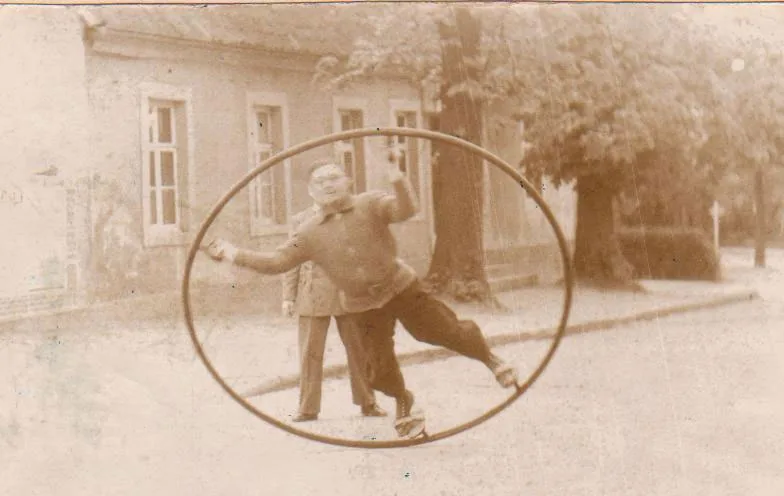
Einreifen: a single-hoop apparatus from the first half of the twentieth century
Another predecessor of the modern Cyr wheel, the Einreifen, was a single steel hoop with handholds and foot supports. According to Valérie Inertie’s overview, its development is associated with Adalbert von Rekowski and dated to around 1930. The exact date still needs to be established.
Its combinations resembled German wheel movements: straight-line rolling, spirals and coin spins. Inertie’s account says that the waltz was not performed on it. The overview also refers to the cover of a March 1951 issue of Die Woche im Bild, which credits Rekowski with the invention.
This apparatus never became as widespread as the German wheel, but it survives in archival photographs. The overview mentions a demonstration at the German wheel championships in Hanover in 1960.
The modern Cyr wheel
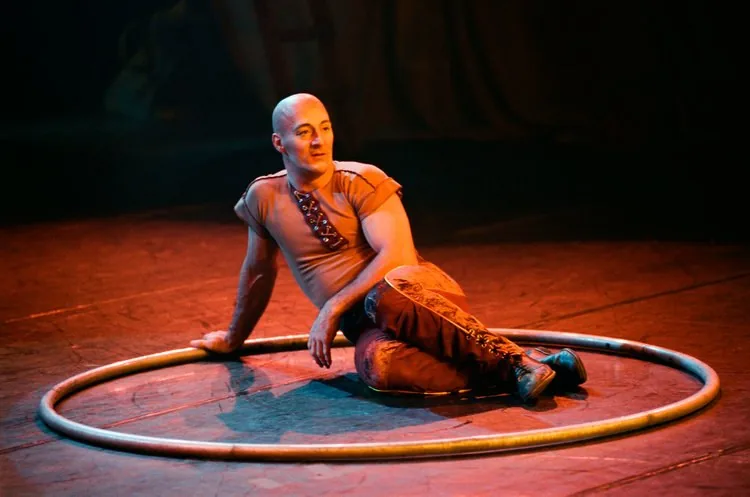
The modern Cyr wheel takes its name from Canadian artist Daniel Cyr, who developed the apparatus and the techniques for working with it in the late twentieth century. Similar single-hoop apparatus existed earlier. Cyr’s work helped shape the modern circus discipline.
A Cyr wheel is a single hoop made of aluminium or steel. Its size is chosen to suit the artist and their goals. A characteristic movement is called the waltz: continuous rotation while shifting body weight and maintaining balance. The explorations of Daniel Cyr and other artists led to developments in the apparatus and the technical vocabulary used in training.
Daniel Cyr was born on the Magdalen Islands in Quebec and graduated from the National Circus School in Montreal. He became known for his acrobatic act on a free-standing ladder. In 1993 he co-founded Cirque Éloize, where he also worked on developing acrobatic apparatus.
According to Inertie’s historical overview, Cyr made his first wheel in 1996. He was inspired by a large hula hoop and a rotating iron coat rack. The wheel was rough because it was made from untreated steel. Daniel added a polyvinyl chloride (PVC) coating to improve the wheel’s grip on the floor, then developed a design that could be taken apart into several sections.
In 1998 Cyr presented the wheel in Cirque Éloize’s show Excentricus. The show itself had premiered a year earlier. In 2003 Daniel won a silver medal at the Festival Mondial du Cirque de Demain in Paris. Interest in the apparatus grew after that, and the Cyr wheel began appearing in the programmes of artists and circus schools in different countries.
For beginners
It all starts with choosing the wheel size and direction of rotation. The usual formula for the wheel’s internal diameter is “your height + 10 cm”, but IRV (International Wheel Gymnastics Federation) has now changed the sizing to “your height + 20 cm”. This is to make the gymnast’s body lines visible. It also means you will not have to arch your back as much in elements performed on the hands, such as a handstand.
Everyone chooses the direction of rotation that suits them. I use the acrobatic cartwheel as a guide: I look at which hand a person naturally leads with. This is the method I use in my teaching. Being right-handed or left-handed alone is not enough to decide the direction. What matters next is that the chosen side feels comfortable as you learn cartwheels, coin spins, the hand-held waltz and other elements.
The wheel’s weight matters too. With a similar diameter, a lighter wheel is usually easier to get moving and stop. A heavier wheel has more inertia, and you need to know how to control it. The diameter, weight distribution, wheel coating and floor also affect how smoothly it rolls.
Training requires a clear space with no people or obstacles in the wheel’s path. The instructor determines how much space a particular session needs, taking into account the student’s experience and the exercises.
The floor needs to be hard, level and smooth, with suitable grip. The wheel should roll predictably, without slipping or stopping abruptly. Carpet and soft surfaces that let the wheel sink in or get stuck are not suitable. A dance floor covering may work if it allows the wheel to roll properly. Rubber flooring needs to be assessed by its properties: the material’s name alone is not enough to judge.
Before training, check the section joints, fasteners and wheel coating. Dust and dirt change the grip on the floor. Learn your first movements with an instructor.